BKS and BMS leaders have told the BJP leadership that it is staring at a build-up of anti-government propaganda in the run-up to polls in five states.
'Opening everything is not appropriate ... everyone has been saying the third wave is a couple of days away'

The first part of the study conducted by the Indian Council of Medical Research (ICMR) revealed that 0.73 per cent of the population surveyed showed evidence of past exposure to SARS-CoV-2, and that urban slum population was the most vulnerable to the infection, ICMR Director General Balram Bhargava said at a press conference.
With the two members quitting, the NSC now has only two members -- Chief Statistician Pravin Srivastava and NITI Aayog CEO Amitabh Kant.

"Also, 35 per cent deaths were recorded in the age group of 45-60 years, 10 per cent in the age group of 26-44 years and one per cent each in the age group of 18-25 years and below 17 years," the health secy said.

The NTAGI has also stated that those having laboratory test proven SARS-CoV-2 illness should defer COVID-19 vaccination for six months after recovery, the sources said.
'Except for the Akali Dal and Shiv Sena, the BJP has not found any permanent friends.' 'This is because most parties are genuinely concerned about what Hindutva politics does to Indian society,' argues Aakar Patel.

The government's predicament is a result of its own doing: That of not ensuring adequate buy-in by the stakeholders before passage of the laws, notes Vivek Gumaste.

'Growth is predicated on the misery of large sections of people.' 'Maybe Hindutva will be used to suppress any such unrest.'

'We have the technical expertise, and international collaborations. We also have robust real-time data. We are a university of pandemic management. If the ministry neglects the role of NCDC, it is the loss of the country'

We need to give a booster shot to all our frontline workers first as if they fall victim to Omicron, the health system will collapse, points out Ramesh Menon.

The government plans to rationalise trade margins for many other medical devices, besides stents and knee implants.
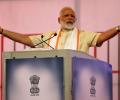
The GST's significance for the BJP's politics is as important as its implications for the Indian economy, says A K Bhattacharya.

E-cigarettes pose a huge health risk to users, who more often than not are adolescents and young adults
Country's economic growth at 9% requires exports to rise by around 20%, says NSC chairman Pronab Sen

'With over 50 per cent of medical seats reserved for those who have the ability to pay a fee ranging from Rs 50 lakh to Rs 1.5 crore for a five-year MBBS course and quotas in accordance with affirmative policies in government colleges, the band of seats available for the not-so-rich and non-OBCs is very narrow.'

With certain quarters demanding privatisation of public sector banks in the aftermath of the alleged fraud at Punjab National Bank (PNB), Economic Advisory Council to the Prime Minister chairman Bibek Debroy tells Sanjeeb Mukherjee, Ishan Bakshi and Indivjal Dhasmana that reducing government equity even to zero would not mean giving up of government control over these banks.

'Poor home work, and a subsequent loss of nerve.' 'This sums up the Modi government's current travails, the stall in key sectors, fading momentum, irritability,' points out Shekhar Gupta.

Prime Minister Modi felt there were too many silos with no arrangement to take a comprehensive view on national security. The PM has entrusted NSA Ajit Doval to evolve a comprehensive roadmap and get it implemented, reveals Nitin Gokhale, Editor-in-Chief, Strategic News International.
T C A Anant, former chief statistician to the government, will soon be heading a panel to decide whether the monthly payroll data released by EPFO, ESIC and PFRDA could replace the quarterly enterprises-based survey on job creation by the labour bureau, the prime minister's office decided last week.

Dr Arun Jamkar, former vice chancellor, Maharashtra University of Health Sciences, makes a strong case for reforming Indian medical education and believes that the National Medical Commission Bill is historic.

Whether it's about colonising Mars or donning Net-connected apparel, 2022 is a year everyone seems to be planning for, says Nivedita Mookerji.

A massive pan-India inoculation drive against COVID-19 was set in process on Tuesday with more than 56 lakh doses of the Covishield vaccine flown to 13 cities across India from Pune and taken to designated national and state-level stores amid tight security.
The lockdown in India has been a timely, graded, proactive and pre-emptive public health measure to fight the COVID-19 pandemic and has been part and parcel of the government's overall strategy, Dr V K Paul, Member (Health), NITI Aayog, and Chairman, Empowered Group 1, said at a media briefing on the COVID-19 situation.

The payments industry is at a crossroads with the banking regulator on two pressing issues, neither of which seems headed towards an amicable solution. Depending upon which side accommodates the other, customers in India will have to choose between convenience and ironclad safety. In the end, the Reserve Bank of India (RBI), which regulates both banks and all payments services providers, will prevail. But the question is: will it do so by bending a little or by sticking to its firm stand? The two issues - one concerning payment facilitators storing customers' card details and the other about auto-renewal of payments - appear similar but aren't.

'The time has come to incorporate Indian sociology into economic policy.' 'The first step in that direction would be to listen to economists trained in India and not just the US and the UK, argues T C A Srinivasa-Raghavan.

Ajit Doval is now India's all-powerful security boss. This concentration of power disrupts our layered security system. Will it not weaken whatever remains of the power and authority of the home, defence and finance ministers? asks Shekhar Gupta.

'This country today is demonstrating to the world the true meaning of federalism, the true meaning of working in partnership between the central government and the state governments.'

'This announcement is big foolishness.' 'The government has no idea of economics. They are just announcing what comes to their mind.' 'Let them implement what they have announced and just see what will happen in two years.'
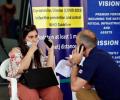
'The information is used only to fight the COVID-19 virus and the privacy terms explicitly state that information will be used only for this purpose.'

The Child Protection Services programme under the Integrated Child Development Services was increased to Rs 1,500 crore from Rs 925 crore.
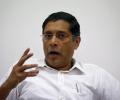
Chief Economic Advisor Arvind Subramanian says that he hopes GDP growth will be at the upper end of the 7-7.5 per cent range.


All international passengers will henceforth be screened at airports, Health Minister Harsh Vardhan said at a press conference. Earlier, travellers from only 12 countries were screened at airports for the disease that has claimed over 3,000 lives and infected more than 90,000 worldwide.
 © 2026 Rediff.com - Advertise with us - Disclaimer - Privacy Policy - Sitemap - Feedback - About us - Terms of use - Grievances